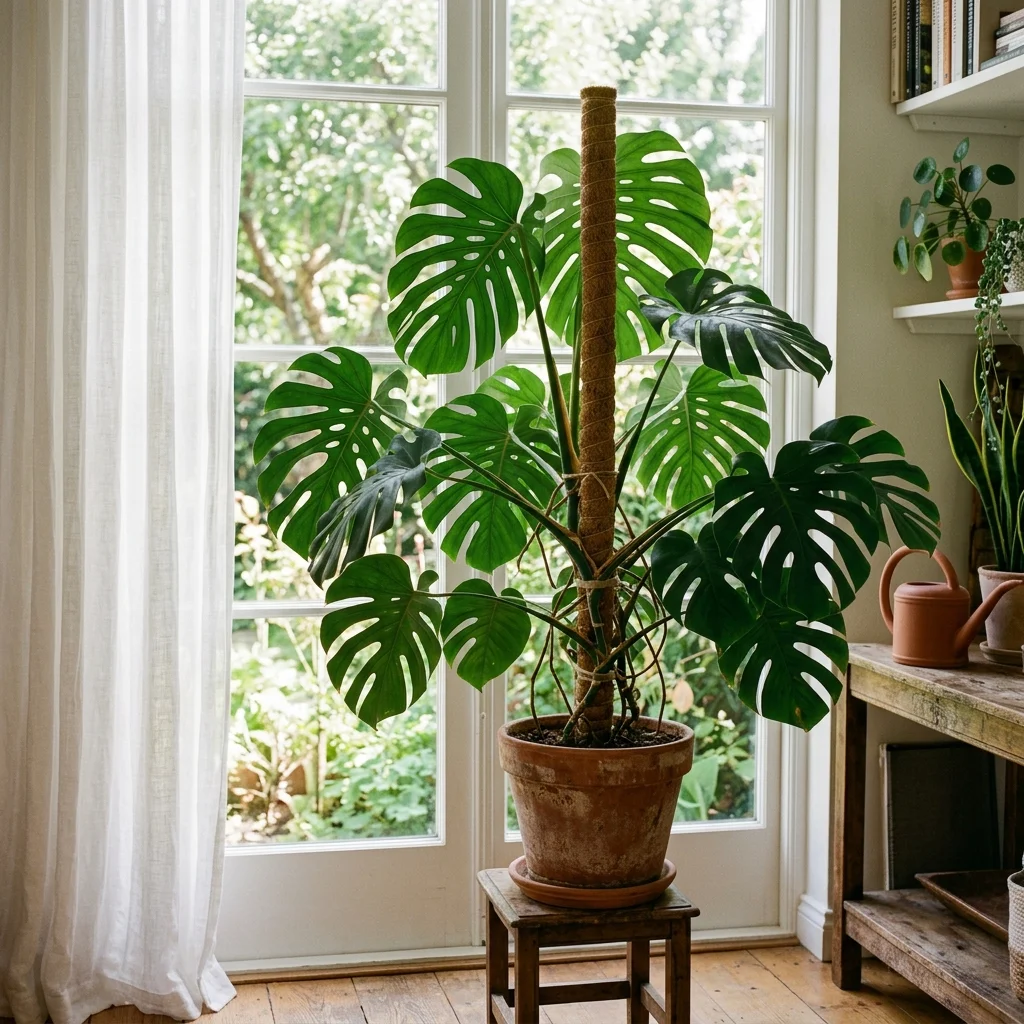
Place Monstera deliciosa in bright, indirect light, let its potting mix become almost dry before watering, and give its climbing stems sturdy support. Use an open, well-drained mix, keep the plant warm, and never leave its pot sitting in water. The Royal Horticultural Society’s growing guide covers these core conditions for Swiss cheese plants.
Light
Set your Monstera near an east- or west-facing window, or in a bright room away from the glass. Strong direct sun can scorch the leaves. In very low light, the plant may grow more slowly and develop fewer holes. Young leaves often lack the splits and holes seen on mature plants. The RHS recommends filtered or indirect light.
Water and potting mix
Check the mix before watering. When it is almost dry, water thoroughly and let the excess drain away. Empty the saucer or cover pot so the roots are not left standing in water. The plant may need water less often during winter, when growth and drying can slow. The RHS watering guidance recommends letting the compost become almost dry and reducing watering in winter.
Choose an open, well-drained potting mix. The RHS describes a slightly acidic compost and gives a peat-free ericaceous and orchid compost blend as one option. A pot with drainage holes is essential.
Repot when roots fill the pot, the mix dries unusually quickly, or the plant becomes unstable. Choose a pot only a few centimeters, about an inch, wider than the root ball. A much larger pot can hold moisture for too long. University of Minnesota Extension lists signs that a Monstera needs repotting, while the RHS advises against a pot much larger than the root ball.
Temperature, humidity, and support
Keep the plant warm, ideally around 18 to 25 C (65 to 77 F), and away from cold drafts and direct heat from radiators or heaters. Monstera prefers moderate humidity. If indoor air is very dry, the leaf edges may turn brown. The RHS suggests grouping tropical plants, misting the leaves, or placing the pot above damp gravel.
Monstera is a climber with aerial roots. Tie the stems loosely to a moss pole or other sturdy support. As the plant matures and climbs, it may produce larger leaves with more holes. The RHS describes training plants onto a moss pole and pruning them to control size.
Feeding and pruning
Feed with a balanced liquid fertilizer while the plant is actively growing. The RHS recommends monthly feeding during the growing season and gives April to September as its timing. In the United States, follow the plant’s growth rather than a fixed date range, and reduce or pause feeding when growth slows in winter.
If the plant outgrows its space, prune it in spring. New growth after pruning may have smaller leaves with fewer holes for a while. Wipe dust from the leaves with a damp cloth.
Propagation
To propagate Monstera from a stem cutting, include a node with an axillary bud. A leaf without a node will not grow into a new plant. Place the cutting in a rooting medium and keep the medium moist but well-drained while roots form. Excessively wet, cool soil can cause cuttings to rot. University of Minnesota Extension explains node selection and care for cuttings.
Pet and handling safety
The RHS identifies Monstera deliciosa as harmful if eaten and an irritant to skin and eyes. Wear gloves and other protective equipment when handling it, and keep the plant away from children and pets.
The ASPCA lists Monstera deliciosa as toxic to dogs and cats because it contains insoluble calcium oxalates. Chewing or swallowing it can cause oral irritation, burning in the mouth, drooling, vomiting, and difficulty swallowing. Contact a veterinarian if a pet eats any part of the plant. See the ASPCA’s species-specific Cutleaf Philodendron entry for Monstera deliciosa.